1. Your Best Customer Never Calls You
Your best customer never calls you—not because they never have problems, but because they rarely feel them. Their WiFi slows for a few seconds and recovers. Their 5G signal drops and returns. A router starts to overheat, and the issue is identified before it becomes a disruption.
Those customers may think you have the best network in the country. Behind that experience is a team that can see what is happening and respond quickly.
Now think about the customer who has to call three times to fix the same problem. The first call is annoying, the second is frustrating, and the third may be the moment they decide to switch providers.
What if those calls never happened? DevicePulse.AI is designed to help ISPs detect, diagnose, and resolve supported network issues before they become customer complaints.
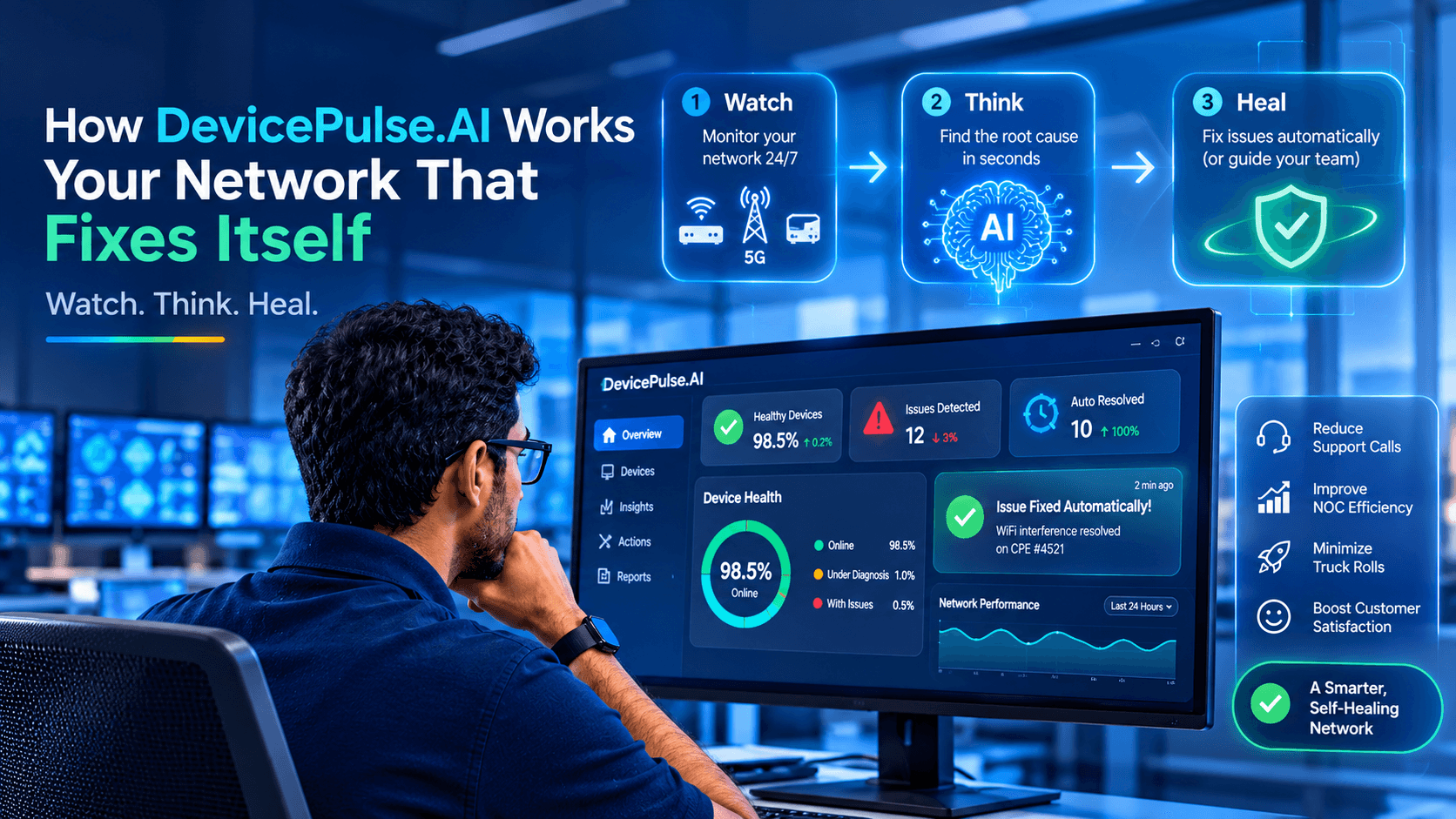
2. Step 1: The Agent Watches—24/7, Across Every CPE
Traditional tools often check whether a device is online or offline at set intervals. DevicePulse.AI takes a broader approach, continuously analyzing available device and network information across routers, 5G CPEs, and ONTs.
Rather than checking connectivity alone, the Agent looks for context that can help explain whether a device is performing as expected.
- WiFi health: channel interference, signal strength, and band steering.
- 5G health: signal quality and network congestion.
- Device health: CPU usage, temperature, reboot loops, and firmware changes.
- Customer experience: whether a device is performing as expected, not only whether it is online.
3. Step 2: The Agent Thinks—Root-Cause Analysis in Seconds
Traditional monitoring tools can generate alerts—sometimes hundreds of them—leaving technical teams to investigate each issue. DevicePulse.AI goes beyond alerts by helping teams understand what may be causing a problem.
When something goes wrong, the Agent analyzes the available information much like an experienced network engineer:
- Correlates WiFi, 5G, device health, and historical data.
- Compares whether an issue affects one customer or multiple customers in the same area.
- Diagnoses whether the likely cause is a router issue, signal problem, or device placement.
Real example: “My WiFi is slow.”
A traditional tool may report only that the device is online. DevicePulse.AI can surface a more useful investigation: “Possible root cause: The CPE is overheating because it is placed inside a closed cabinet. This may affect WiFi performance. Moving the device to an open space is recommended. Channel 11 also appears congested, so switching to a clearer channel may improve performance.”
That is more than an alert. It is an actionable diagnosis for the support team to review.
4. Step 3: The Agent Heals—Before the Customer Calls
Self-healing becomes valuable when the Agent can do more than identify a problem. Through available integrations and APIs, it can trigger approved corrective actions automatically, securely, and remotely where supported.
- WiFi interference: switch to a cleaner channel where supported.
- Congested 5G band: recommend or trigger a band change where supported.
- Incorrect configuration: apply the correct configuration.
- Unresponsive router: trigger a controlled reboot when appropriate.
- Firmware issues: initiate an approved firmware update.
When a remote fix is not enough
Some issues need a person on site—for example, a CPE that must be physically repositioned. In those cases, the Agent can give the support team diagnostic information and recommended next steps instead of making them start from scratch.
For example: “Customer #8821 — CPE repositioning recommended. Moving the device closer to a window may improve signal quality. Preferred contact time: 6–7 PM. Suggested troubleshooting steps are included.”
5. What Does This Mean for Your ISP?
AI matters when it helps the business and the people running the network. A more intelligent, self-healing network can help ISPs:
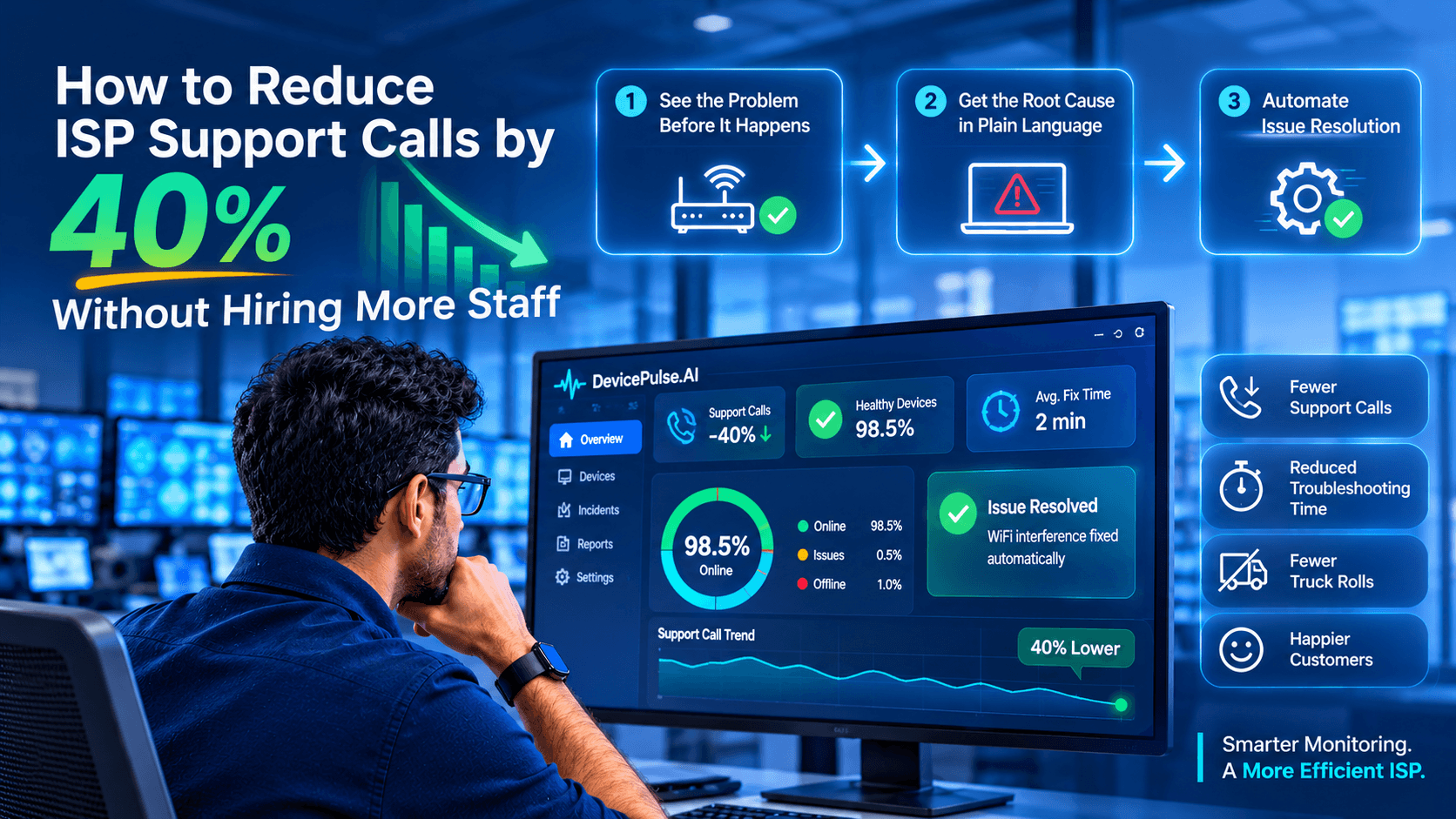
- Reduce support calls by resolving common device and connectivity issues before they become customer complaints.
- Improve NOC efficiency by giving teams root-cause insights and recommended actions sooner.
- Reduce unnecessary truck rolls by identifying problems that can be resolved remotely.
- Improve customer experience and retention through faster responses to connectivity issues.
- Scale network operations without increasing manual troubleshooting at the same rate as the number of CPEs.
6. DevicePulse.AI vs. Traditional Monitoring
Traditional monitoring focuses on alerts and device status. DevicePulse.AI adds analysis and guided response to help teams move from a notification to an informed next step.
- Traditional monitoring shows alerts and device status; DevicePulse.AI analyzes issues and identifies potential root causes.
- Traditional monitoring often reacts after an issue is reported; DevicePulse.AI helps detect issues before customers complain.
- Traditional monitoring relies heavily on manual troubleshooting; DevicePulse.AI supports automated diagnosis and corrective actions.
- Traditional monitoring requires teams to interpret technical logs; DevicePulse.AI provides actionable insights in plain language.
- Traditional monitoring offers limited visibility into device behavior; DevicePulse.AI analyzes multiple sources of device and network information.
7. Do You Need to Replace Your Current System?
No. DevicePulse.AI is designed to work alongside existing network management platforms and connected CPEs.
You do not need to replace your current infrastructure or start from scratch. DevicePulse.AI adds an AI intelligence layer to help teams understand device behavior, identify potential root causes, and automate supported corrective actions.
8. The Future Is Self-Healing Networks
Self-healing capabilities are becoming increasingly important for ISPs managing large numbers of connected devices. The question is whether your network will continue relying on customers to report problems or become better equipped to identify and resolve issues proactively.
Rather than adding support resources to keep pace with customer demand, ISPs can introduce an AI Agent that helps teams detect, diagnose, and resolve common issues.
Your network should not have to wait for a customer to complain before a problem gets fixed. It should be able to fix itself.